
4
Novel Non-Rotational Mixing
Inspired by nature, the Minifor2Bio touch uses an innovative up-and-down agitation with biomimicking fish-tail= discs. This simple yet highly effective mixing ensures easy sterility and thorough culture homogenization, all without complex magnetic coupling.

Why LAMBDA uses non-rotational mixing system?
Conventional laboratory fermenters and bioreactors almost exclusively use rotational agitation to mix the culture medium. Although this approach has become the industry standard, it introduces a fundamental engineering challenge. The stirrer shaft rotates while the vessel remains stationary, making it necessary to provide a clearance between the rotating shaft and the fixed vessel. This clearance must be effectively sealed to maintain sterility throughout the cultivation process.
Several sealing technologies have been developed to address this challenge. Lip seals represent the simplest solution but are subject to wear, particularly during prolonged operation or at high rotational speeds, increasing the risk of contamination. Mechanical face seals provide improved sealing performance but require regular maintenance and replacement, as deposits forming between the sealing surfaces may compromise their integrity over time. Magnetic couplings eliminate direct shaft penetration and provide excellent sterility; however, they are technically complex, expensive and require precise mechanical tolerances. Deposits accumulating within the narrow gap separating the magnetic components may also affect long-term performance.
The LAMBDA Minifor2Bio touch follows a different engineering philosophy by replacing rotational agitation with a vertical reciprocating movement of specially designed stirring discs. Instead of rotating continuously, the stirring assembly moves vertically inside the vessel. This movement allows the shaft to pass through a simple elastic membrane, which simultaneously accommodates the reciprocating motion and provides complete separation between the sterile interior of the vessel and the external environment.
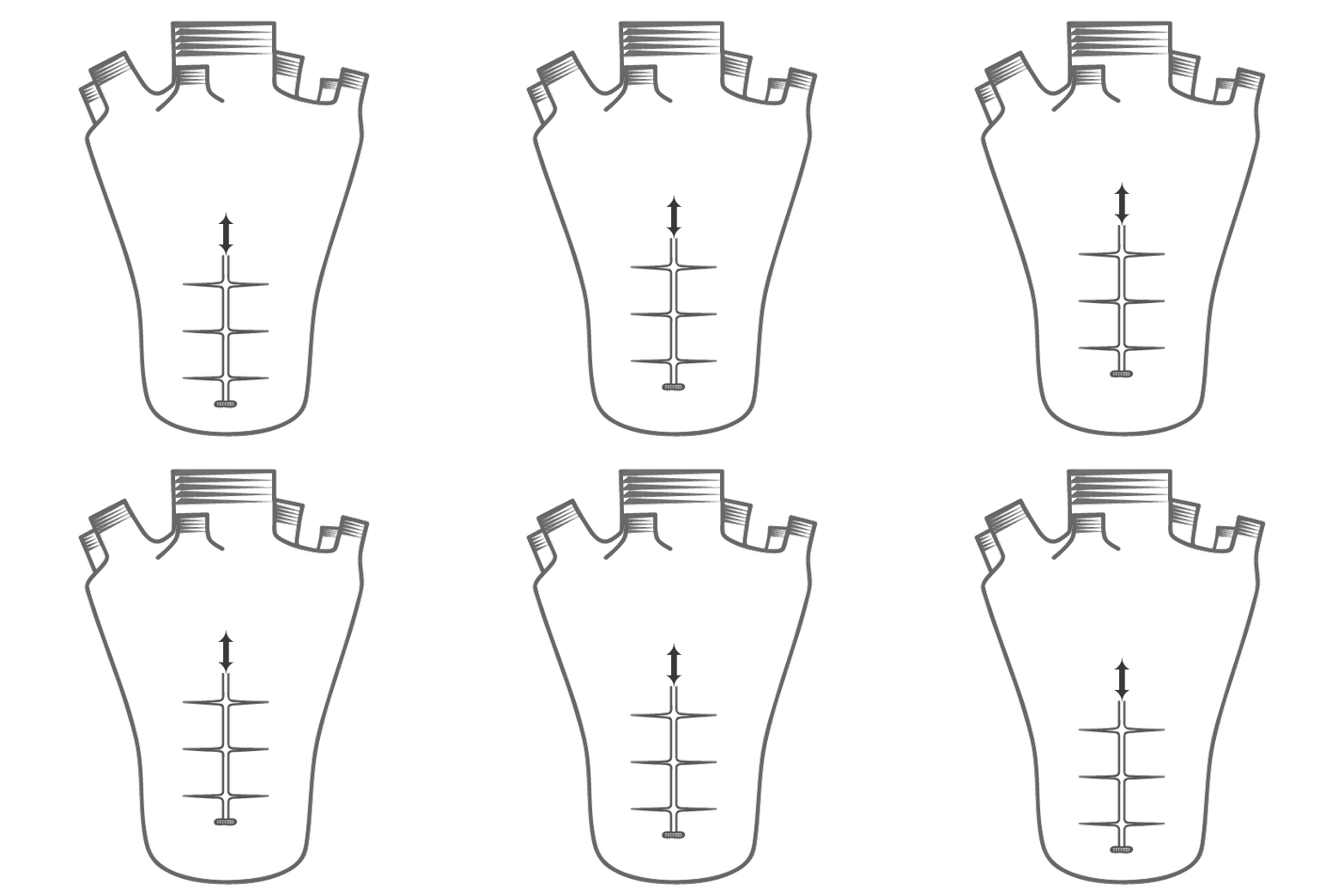
LAMBDA non-rotational mixing system.
Design Advantages
The non-rotational mixing principle provides several engineering advantages beyond reliable sterility.
Because the reciprocating movement does not generate a central vortex, internal baffles are no longer required. Eliminating baffles simplifies vessel construction, reduces cleaning effort and allows the use of a compact threaded vessel architecture, as the large vessel opening normally required for baffle installation is no longer necessary.
The simplified vessel architecture also eliminates the need for conventional stainless-steel head plates and complex rotating shaft sealing systems. Vessel preparation becomes considerably simpler, while changing between different vessel sizes requires only a few low-cost components. The majority of probes, accessories and system components remain unchanged, significantly reducing the cost of process development and scale-up.
The modular vessel concept allows interchangeable culture vessels with working volumes ranging from 35 mL to 7 L. Researchers can therefore select the most appropriate culture volume for each experiment rather than choosing unnecessarily large vessels to accommodate future applications. Working with smaller culture volumes reduces media consumption, preparation time and operating costs while increasing experimental flexibility.
The non-rotational mixing principle also supports several other engineering concepts incorporated into the LAMBDA Minifor2Bio touch. Eliminating internal baffles enables the compact threaded vessel design, while simplified shaft sealing removes the need for expensive head plates. Together with the infrared radiation heating system, these engineering concepts contribute to a compact, modular and highly accessible bioreactor platform.
By replacing conventional rotational stirring with a non-rotational reciprocating mixing system, the LAMBDA Minifor2Bio touch combines effective mixing, reliable sterility and simplified mechanical construction in a design that supports modern fermentation and cell culture applications.