8
Exceptional 35 mL to 6 L Working Volume Range
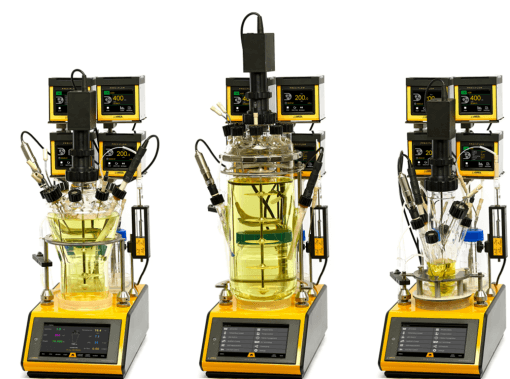
A single Minifor2Bio touch base unit supports interchangeable Pyrex vessels ranging from micro-screening volumes (35" mL" ) up to full benchtop production capacities (6" L" ). Process screening, media development, and scale-up studies can be performed on the exact same console hardware.

Recent advances in analytical methods and sample preparation allow researchers to run highly reliable bioprocesses using significantly smaller working volumes.
The Minifor2Bio touch fermenter-bioreactor is engineered to optimize cell culture conditions in compact 1-liter vessels—eliminating the need for traditional 3L to 14L systems.
Using a single instrument, Minifor2Bio touch accommodates working volumes ranging from 35 mL to 6 liters across five interchangeable vessel options.
Key Advantages of Low-Volume Bioprocessing
Time Efficiency: Faster media sterilization, heating, and cooling cycles drastically reduce turnaround time.
Cost Reduction: Minimizes expense across media consumption, sterilization equipment (smaller autoclaves), downstream processing, and waste disposal.
Uncompromised Process Control: Precise parameter monitoring remains stable, allowing larger relative sample withdrawals without affecting culture regulation.
Continuous Culture Support: An optional weighing scale module (Channel X) enables continuous operation, boosting productivity by over an order of magnitude and achieving high biomass yields in minimal vessel sizes.
Vessel Specifications
par
Vessel Type | Working Volume | Vessel Height | Vessel Diameter | Typical Application |
0.3 L | 35 mL – 400 mL | 34 cm | 22 cm | Micro-scale cultivation & screening |
0.4 L | 150 mL – 450 mL | 22 cm | 23 cm | Low-profile benchtop fermentations |
1.0 L (Recommended) | 300 mL – 1.7 L | 34 cm | 25 cm | Optimal laboratory optimization & R&D |
3.0 L (Recommended) | 500 mL – 3.0 L | 37 cm | 34 cm | Standard lab-scale bioprocessing |
7.0 L | 1.0 L – 6.0 L | 50 cm | 30 cm | Maximum volume scale on single unit |
*Note: Working volumes and vessel dimensions are approximate for autoclaving with standard accessories and vary by application.
Understanding Project Stages in Biotechnology
Successfully bringing a biotechnological product from concept to commercialization relies on maintaining clear distinctions across three development phases:
Laboratory Scale (Research & Optimization)
Objective: Select production strains and pinpoint optimal living and growth conditions.
Strategy: Work with the smallest practical volumes (~1L). Cells respond to their micro-environment, not total volume. Minimizing working volume speeds up setup, reduces media and utility costs, simplifies handling, and enables strict parameter control and contamination prevention. Thorough R&D at this stage saves substantial capital downstream.
Pilot Scale (Scale-Up)
Objective: Identify engineering parameters, aeration limits, mixing behaviors, and downstream equipment required to replicate lab-scale optimization at scale.
Strategy: Transition to larger industrial pilot reactors. Intermediate 10-liter vessels often fail to expose large-scale mass transfer limitations; realistic scale-up requires dedicated pilot infrastructure. Pilot trials typically cost 10x more than lab-scale research.
Industrial Scale (Production)
Objective: Execute full-scale commercial manufacturing with high efficiency and throughput.
Strategy: Rely entirely on validated parameters from prior stages. Plant modifications at this level are prohibitively expensive, making accurate lab- and pilot-scale data critical prior to buildout.